Core vs Liquid Aeration in Apple Valley Minnesota Yards
Choosing between core and liquid aeration for your Apple Valley lawn comes down to understanding what your soil actually needs. Dakota County yards — especially those built on the heavy clay soils common throughout the south metro — respond very differently to each method. If you've noticed water pooling after rain, turf thinning in high-traffic areas, or fertilizer applications that don't seem to do much, compaction is likely the root problem. Knowing how each aeration type works helps you make a smarter investment in your lawn's long-term health.
How Core Aeration Works
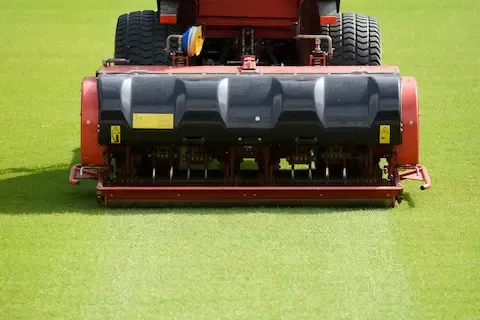
Core aeration, sometimes called mechanical or plug aeration, uses a machine fitted with hollow tines that punch down into the soil and pull out small cylinders of earth. These typically two to three inches deep and about a half inch in diameter — are deposited on the surface where they break down naturally over a few weeks. The holes left behind allow air, water, and nutrients to penetrate directly into the root zone where compaction has been blocking them.
In Apple Valley, core aeration is particularly effective on clay-heavy lawns that have been compacted over years of foot traffic, heavy mowing equipment, and Minnesota's freeze-thaw cycles. The physical removal of soil material is the key advantage. You're not just loosening what's already there — you're creating genuine space within the soil profile. For lawns that haven't been aerated in several years, or properties with obvious thatch buildup, core aeration delivers results that liquid products simply cannot replicate.
The timing matters in Minnesota. Fall aeration, typically between late August and mid-October, allows cool-season grasses like Kentucky bluegrass and fescue to recover before dormancy while taking advantage of softer post-summer soil. Spring aeration is also an option but should avoid periods when the ground is still saturated from snowmelt. Our lawn aeration services are scheduled around these optimal windows.
What Liquid Aeration Actually Does
Liquid aeration involves applying a soil amendment solution — typically containing wetting agents, humates, or biological stimulants — across your lawn using a sprayer. The formulation works by helping water molecules penetrate hydrophobic or compacted surface layers and by encouraging microbial activity that naturally loosens soil structure over time.
Liquid aeration does not physically remove anything from your soil. That distinction matters. What it excels at is addressing mild surface compaction, improving water infiltration in soils that have become somewhat hydrophobic, and reaching areas where mechanical equipment can't go — tight corners, slopes, or landscaped areas around tree roots. It's also a gentler option for newer lawns where disturbing the turf with heavy equipment isn't ideal.
For Apple Valley homeowners dealing with moderate compaction or looking to supplement a core aeration program, liquid products can extend the benefits between mechanical treatments. However, treating it as a complete replacement for core aeration on heavily compacted Dakota County clay soil is where many homeowners run into disappointment.
Comparing Results Side by Side
The honest comparison between these two methods comes down to severity of compaction and long-term goals. Here's how they stack up across the factors that matter most for Minnesota lawns:
Depth of treatment: Core aeration reaches two to three inches into the soil profile. Liquid aeration primarily affects surface layers and relies on biological processes that take weeks or months to show results.
Speed of results: Core aeration shows measurable improvement in water infiltration and root growth within one growing season. Liquid aeration works more gradually.
Thatch reduction: Mechanical aeration breaks up thatch directly. Liquid products can stimulate microbial breakdown of thatch but do not mechanically address heavy buildup.
Equipment access: Core aerators are large and require open turf. Liquid aeration can reach everywhere.
Cost per application: Liquid aeration is typically less expensive upfront, though core aeration usually delivers more value per dollar on compacted lawns.
When Apple Valley Lawns Benefit from Both
A combined approach is often the smartest strategy for Dakota County homeowners managing lawns through Minnesota's demanding seasonal transitions. Core aeration once or twice a year handles the deep compaction that builds up from heavy snowfall, spring thaw, and summer drought stress. Liquid aeration, applied in between or as a complement to mechanical treatments, maintains improved water infiltration and supports microbial health throughout the growing season.
Newly seeded areas or lawns recovering from renovation benefit from liquid aeration early in the process before the turf is established enough to handle mechanical equipment. Once the grass has filled in fully, transitioning to an annual core aeration schedule keeps the soil profile open for the long term.
If your lawn has visible thatch exceeding half an inch, standing water after average rainfall, or noticeably thin grass in high-traffic zones, mechanical core aeration should be the starting point — not a supplement. Liquid products alone won't resolve those conditions on Apple Valley's clay-dominant soil types.
Common Mistakes Homeowners Make Choosing Between Them
One of the most frequent errors is choosing liquid aeration primarily because it's cheaper or more convenient, then expecting core aeration results. Marketing for liquid products sometimes implies equivalence with mechanical aeration, and for lawns with significant compaction, that comparison simply doesn't hold up.
Another mistake is aerating at the wrong time. Aerating during drought stress or when the soil is bone-dry causes the tines to bounce across the surface rather than penetrating effectively. After heavy rain when the ground is saturated, plugs can seal back over before they fully benefit the lawn. Timing aeration to moist but not wet soil — which in Minnesota typically follows a day or two after irrigation or moderate rain — produces the best results.
Skipping overseeding after core aeration is also a missed opportunity. The open channels created by mechanical aeration are ideal seed-to-soil contact points, and fall overseeding combined with aeration is one of the most cost-effective turf improvement strategies available to Apple Valley homeowners. For a broader look at how these treatments work together, our our aeration and overseeding overview covers the full process in detail.
Making the Right Call for Your Lawn
Most Apple Valley lawns on Dakota County's clay-heavy soils will get the most out of annual core aeration as their primary compaction management tool. Liquid aeration works well as a complement, as a solution for areas mechanical equipment can't reach, and for homeowners maintaining already-healthy turf who want to support soil biology between full mechanical treatments.
If you're unsure where your lawn falls on the compaction spectrum, a simple screwdriver test tells you a lot. Push a standard screwdriver into your lawn with moderate pressure. If it resists past two inches, your soil is compacted enough that mechanical aeration should be part of your plan. If it slides in easily, your soil may be in reasonable shape and liquid products could be sufficient for maintenance.
