Overseeding Compacted Orchard Soil in Apple Valley MN
Orchard soil in Apple Valley presents a unique challenge that standard overseeding approaches simply weren't designed to handle. Legacy Dakota County apple orchards left behind decades of foot traffic, equipment passes, and root decomposition cycles that compress and stratify soil in ways that differ significantly from typical residential turf. If you're working with a property that once hosted fruit trees — or sits adjacent to former orchard land — understanding what's happening beneath the surface before you seed makes the difference between a lawn that takes hold and one that struggles season after season.
Why Orchard Soil Behaves Differently Than Standard Lawn Soil
Former orchard sites in the Apple Valley area carry a distinctive soil profile. Repeated harvest equipment passes over the same corridors create compaction layers — sometimes called hardpans — that sit anywhere from four to ten inches below the surface. These layers are dense enough to block water infiltration and restrict root penetration. On top of that, decayed root channels from removed apple trees create irregular pockets of organic matter that drain at different rates than the surrounding clay-loam mix common across Dakota County.
What this means practically is that standard single-pass aeration doesn't reach deep enough. A conventional aerator pulls cores to about three inches. In orchard-legacy soil, you need multiple passes in perpendicular directions to break through the compaction layer effectively. Some properties benefit from a second aeration session performed perpendicularly to the first, giving seed and water genuine access to the soil profile below the hardpan.
Matching Seed Blends to Zone 4b and Dakota County Drainage Patterns
Apple Valley sits in USDA Plant Hardiness Zone 4b, and that designation carries real weight when selecting seed blends for overseeding. Turf grasses that perform well in Zone 5 or Zone 6 simply don't survive Dakota County winters with the same consistency. For orchard-legacy soil specifically, the drainage irregularities created by decomposed root channels mean you need blends that tolerate both temporary saturation and dry periods within the same growing season.
Kentucky bluegrass remains the backbone of most successful overseeding blends in this region. It knits together laterally, filling in the uneven patches that former orchard rows often leave behind. A blend that incorporates 60 to 70 percent Kentucky bluegrass with a supporting mix of fine fescue handles the moisture variability well. Fine fescue — particularly hard fescue and creeping red fescue varieties — tolerates the lower-fertility pockets that occur in areas where old root systems have depleted specific soil nutrients.
Avoid heavy perennial ryegrass ratios in these blends. Ryegrass germinates quickly and can look promising early, but it competes aggressively with bluegrass establishment in the first season and often struggles with the freeze-thaw cycles that Apple Valley experiences through late March and early April. If you need a fast-germinating nurse grass to stabilize bare patches, a small percentage of annual ryegrass accomplishes that without compromising the long-term stand.
Timing Overseeding Around Apple Valley's Frost and Soil Temperature Windows
The timing window for overseeding in Apple Valley is narrower than many homeowners expect. Soil temperature needs to reach and hold at least 50 degrees Fahrenheit for Kentucky bluegrass germination to begin reliably. In Dakota County, that window typically opens in mid-August and closes by mid-September. Seeding earlier in August can catch the tail end of summer heat stress, while seeding after mid-September risks germination failing before winter dormancy sets in.
For orchard-legacy properties specifically, soil temperature variation across the lawn can be significant. Low spots where root decomposition occurred may hold moisture and run cooler than adjacent areas. Checking soil temperature at multiple points across the site — not just in a single location — gives you a more accurate picture of whether conditions are uniformly ready.
Fall overseeding also benefits from reduced weed competition. Crabgrass and annual broadleaf weeds are finishing their cycle in late summer, which removes one of the biggest competitive threats to new seedlings. If you applied a pre-emergent herbicide earlier in the season, however, wait for that barrier to break down before overseeding — most pre-emergents remain active for 12 to 16 weeks and will suppress desired grass seed along with weeds.
Aeration Depth and Pattern for Compacted Orchard Profiles
Because orchard-legacy soil in Apple Valley often features that deeper compaction layer, aeration technique matters more than it does on a standard residential lawn. Running a core aerator in a single direction leaves too many undisturbed zones. Two passes at 90-degree angles to each other produce a more uniformly opened surface that allows seed-to-soil contact across the entire area rather than just along parallel rows.
Core spacing also matters. Standard aerator settings space cores at roughly three-inch intervals. Tightening that spacing — or making a third pass in particularly dense areas — improves the outcome meaningfully. After coring, leaving the plugs on the surface to break down naturally adds organic matter back into the soil profile, which is especially valuable on orchard-legacy sites where the soil biology has been disrupted over time.
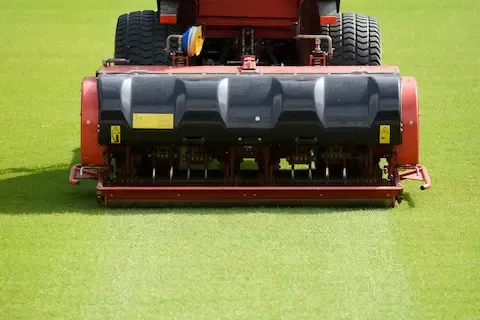
If you're managing this on your own, professional-grade lawn aeration equipment makes a material difference. The weight and tine depth of commercial machines outperforms consumer-grade units on compacted soil, particularly when you need multiple passes to achieve meaningful penetration.
Common Mistakes on Former Orchard Properties
One of the most frequent errors on orchard-legacy soil is treating it as a standard renovation project. Homeowners and even some lawn care providers apply the same seed rates and aeration schedules used on conventional residential turf, then wonder why results are inconsistent. The irregular drainage, compaction depth, and soil nutrition variability of former orchard land require adjusted inputs at every stage.
Another common mistake is skipping a soil test. Orchard-legacy soils in Dakota County often have elevated potassium levels from decades of fruit tree fertilization and depressed pH in certain zones from organic matter decomposition. A basic soil test before overseeding tells you whether you need lime applications to correct pH or whether your starter fertilizer blend needs adjustment to account for existing nutrient levels. Seeding into soil with a pH below 6.0 substantially reduces germination success for Kentucky bluegrass.
Overwatering during establishment is also a persistent problem. Orchard-legacy pockets with decomposed root channels can become waterlogged quickly, creating conditions favorable to fungal issues in new seedlings. Light, frequent watering that keeps the seed zone moist without saturating the soil profile produces better results than heavy infrequent irrigation cycles.
Local Considerations Specific to Apple Valley Properties
Apple Valley's urban tree canopy along former orchard corridors creates shade conditions that interact with overseeding outcomes. If mature trees remain on or adjacent to the property, selecting shade-tolerant fine fescue varieties at higher ratios in the blend compensates for reduced sun exposure in those zones.
Dakota County's storm drainage infrastructure also affects how quickly water moves off former orchard parcels. Properties near the Lebanon Hills Regional Park corridor may experience periodic high water tables that influence how deeply roots can establish before winter. Understanding your specific site's drainage behavior before committing to a seed blend and aeration plan saves you from repeating the process a season later.
Conditions vary more across this city than most homeowners expect, and why Cobblestone Lake lawns recover differently after Minnesota winters is a good example of how much.
For a broader foundation on the process before starting your project, reviewing our aeration and overseeding overview helps set realistic expectations for what the timeline and inputs look like from start to establishment.
Working With What Legacy Soil Gives You
Overseeding compacted orchard soil in Apple Valley isn't a single-season fix. It's a multi-year process of improving soil structure, building organic matter, and establishing a grass stand that matches the Zone 4b climate and the specific drainage patterns of Dakota County. Getting the aeration depth right, matching your seed blend to the site, and timing your work to the correct soil temperature window gives you the best possible foundation for a lawn that performs consistently year after year.
